

In this post: Learn about our Spanish lessons about caring for a baby in our Level 2 curriculum. We’ll share vocabulary, songs, books, and more!
Many kids are fascinated by babies. If you have a baby in the house, your older children probably love helping out with the fun stuff, like feeding and playing with their baby brother or sister.
If that sounds like your child, they’ll love learning all about caring for a baby in Spanish with our lessons on cuidando al bebé.
At Llamitas Spanish, we teach Spanish through thematic units that are cross-curricula. This means all of our lessons incorporate the core subjects—such as phonics, literacy, math, music, and cultural studies—all in Spanish!
Our third unit in Level 2 includes Spanish vocabulary about caring for a baby. Under the larger theme of “Creciendo juntos” (Growing Together), students will also learn about family traditions and celebrations in Latin American culture, including the unique quinceañera celebration for 15 year old girls.
So keep reading to start learning about caring for a baby in Spanish with us.
Table of Contents
Naming Baby Items in Spanish
Learning about baby care comes with its own lingo in any language, so there are plenty of baby item vocabulary words in Spanish. If you have any babies in the family, learning these will also help your child with talking about family members in Spanish too!
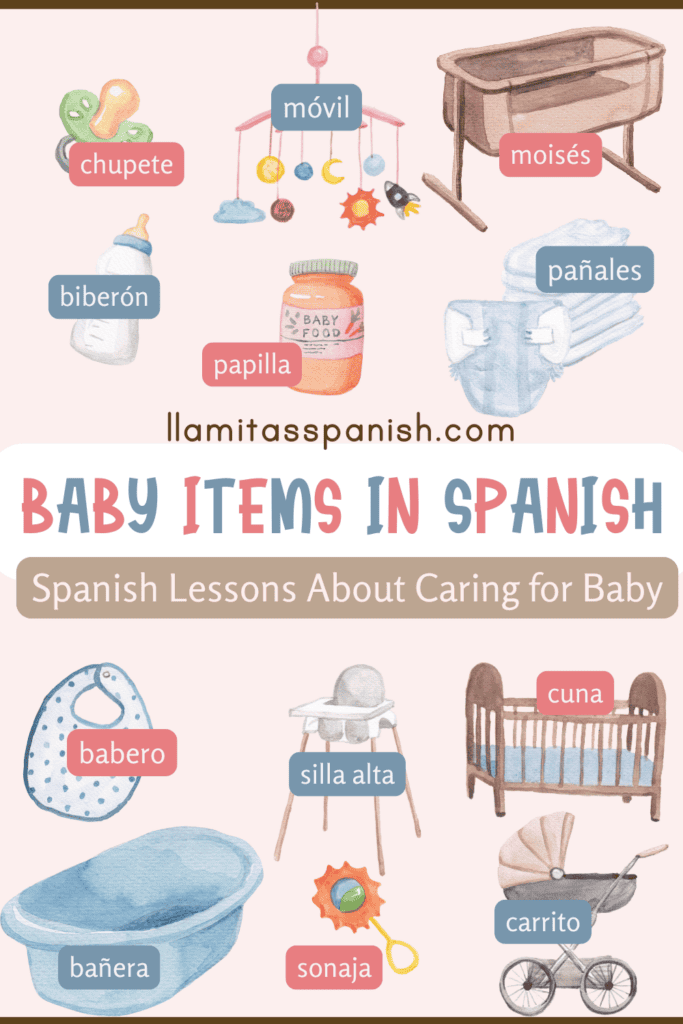
Our unit on growing together will cover all of this and more, but you can start to name baby items in Spanish now with these essential vocabulary words:
| Spanish | Pronunciation | English Translation |
| babero | bah-beh-roh | bib |
| bañera | bah-nyeh-rah | baby tub |
| biberón | bee-beh-rohn | feeding bottle |
| carrito | kah-rree-toh | stroller |
| chupete | choo-peh-teh | pacifier |
| cobija | koh-bee-hah | receiving blanket |
| cuna | koo-nah | crib |
| moisés | moy-sehs | bassinet |
| mordedera | mohr-deh-deh-rah | teething ring |
| móvil | moh-beel | mobile |
| pañalero | pah-nyah-leh-roh | onesie |
| pañales | pah-nyahl-ehs | diapers |
| papilla | pah-pee-yah | baby food |
| silla alta | see-yah ahl-tah | high chair |
| sonaja | soh-nah-hah | rattle |
| toallas húmedas | toh-ah-yahs oo-meh-dahs | wet wipes |
Students will also learn these helpful verbs in the unit:
| Spanish | Pronunciation | English Translation |
| chupar | choo-pahr | to suck |
| dormir | dohr-meer | to sleep |
| limpiar | leem-pyahr | to clean |
| morder | mohr-dehr | to bite / to chew |
| observar | ohb-sehr-bahr | to watch / to look at |
| sacudir | sah-koo-deer | to shake |
Related post: Top 100+ Hispanic and Latino Baby Names
Spanish Song to Sing to Baby
We love to incorporate music in all of our lessons at Llamitas Spanish, so of course this unit also includes a new song to learn as well!
Learning songs isn’t only fun for kids—it helps to reinforce vocabulary and grammar. Studies have actually found that music plays an important role in language development, so be sure to use this to your advantage!
In our Level 1 curriculum, we teach a traditional Spanish lullaby in our unit on family called “Arrorró mi niño.” In this unit, your child will practice another gentle song that’s perfect for babies.
Here are the lyrics in Spanish and English:
| Spanish Lyrics | English Translation |
| ¡A dormir va la rosa De los rosales A dormir va mi niño Porque ya es tarde. Mi niño se va a dormir Con los ojitos cerrados. Como duermen los jilgueros Encima de los tejados. | The rose goes to sleep On the rosebush; My child goes to sleep Because it’s already late My child is going to sleep With eyes closed. Like the goldfinches sleep On the rooftops. |
If you have a little one in the house, your child should get plenty of practice singing this sweet song to them.
Learning Goals in this Unit
Thematic learning is a key component in all of our lessons at Llamitas Spanish. This means that your student will be learning more than grammar—they’ll apply their learning across multiple subjects.
In the first unit of our Level 2 curriculum, students will:
- Learn vocabulary related to baby items.
- Identify more complex 2D shapes (first introduced in Level 1).
- Name attributes of shapes, including similarities and differences.
- Practice skip counting by fives up to 100.
- Recognize “decenas” (tens) and “unidades” (units) in numbers.
- Recognize singular and plural nouns.
- Learn that words ending in “z” become “-ces” in plural form (example: feliz = felices).
- Understand and differentiate between the sounds “c,” “z,” and “s.”
- Recite parts of the poem “Mi pequeño bebé” (My Little Baby).
- Learn the songs “¡Qué linda manito!” (Such a sweet hand!), “A dormir va a la rosa” (The rose goes to sleep), “Tengo una muñeca” (I have a doll), and “La piñata” (The piñata).
Students will also learn about special family traditions in this unit, such as the quinceañera, a celebration that happens when a girl turns 15. Through our short story “Valera la quinceañera” (Valera’s 15th Birthday Party), which is part of our anthology Cuentos Cortos Infantiles, they’ll read about a Mexican girl as she celebrates her beautiful and traditional quinceañera.
Related post: Elementary Homeschool Spanish Curriculum
Homeschool Spanish Curriculum Levels
Llamitas Spanish has everything you need for raising bilingual and biliterate children with our robust open & go curriculum series.
Level 1 is perfect for beginners ages 5–10 and includes fun topics like transportation, family, pets, and more. No prior Spanish experience is needed for this level.
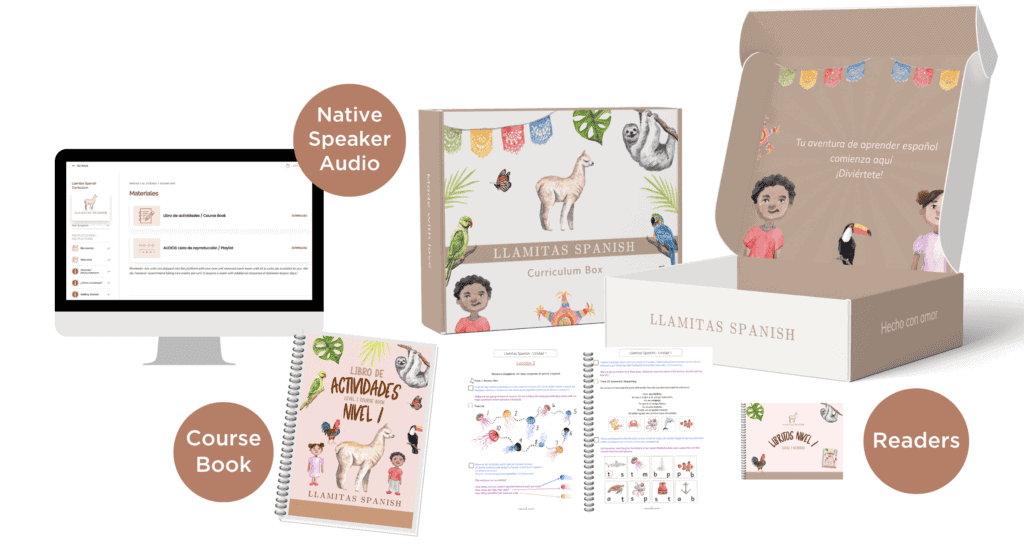
Level 2 is for those who have completed Level 1 or have at least one year of Spanish education. This is where you’ll find lessons about caring for a baby, along with other units on daily routines, hobbies, endangered animals, and many other topics that kids love.
More advanced levels are also available in our shop! All of our curriculum levels come complete with bilingual scripts, activities, music, and more, so you literally just have to open your book and go! No planning or teaching experience is necessary.
Related post: Dual Language Homeschool Education
Related post: How to Add a Foreign Language to Your Homeschooling

Lydia is a freelance parenting and education writer. She previously taught English as a second language and enjoys sharing her love of language learning with her children.