

In this post: Learn all about the learning goals for kindergarten Spanish in this guide. Plus, find out more about our Spanish curriculum for kindergarten so you can teach your child at home.
Learning Spanish in kindergarten is a great way to give your child’s early language development a boost. If you’re raising bilingual children, you may have heard that the sooner you start, the better. And it’s true that teaching Spanish at a young age has many benefits for young learners.
Sharing the gift of bilingualism with your child is a wonderful idea, but you might be full of questions if you’re just getting started. So, what do kindergarteners learn in Spanish?
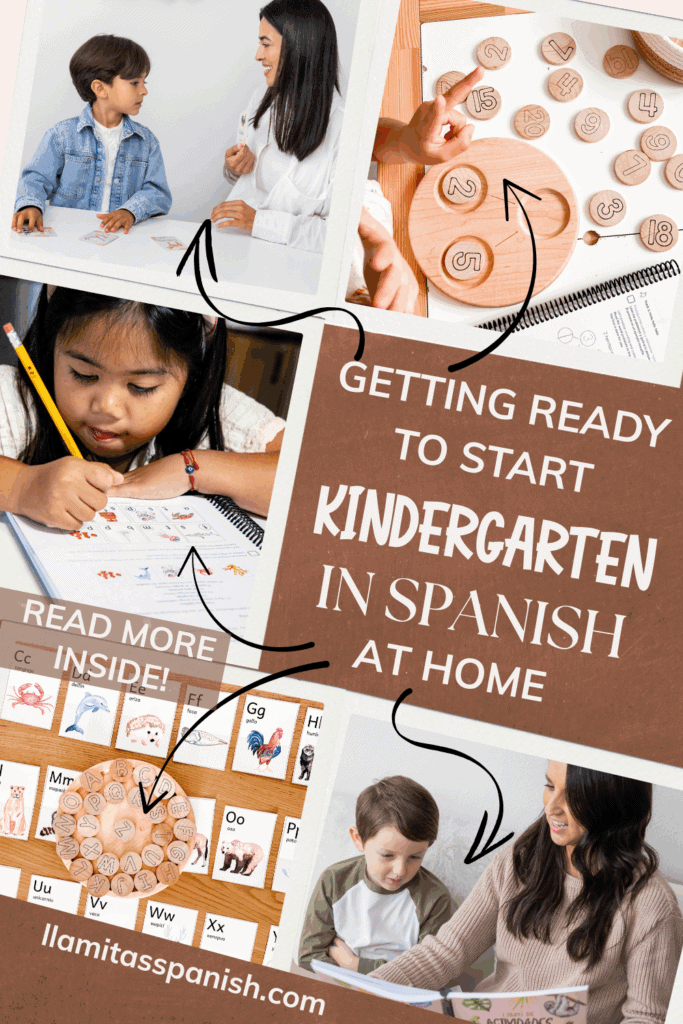
At Llamitas Spanish, our homeschool elementary Spanish curriculum levels have been designed to correlate with grade-level educational standards for Spanish. That means that our lessons cover the same Spanish skills your child would learn in a dual language immersion school as they explore exciting topics in Spanish.
Keep reading to find out everything you need to know about teaching Spanish in kindergarten.
Table of Contents
Kindergarten Spanish Phonics
At the kindergarten level, Spanish learners will begin to build skills in early language development, such as:
- Alphabet recognition
- Letter sounds & CV (consonant-vowel) syllables
- Syllable awareness
These are the same skills children are expected to learn for English language arts in kindergarten—but instead they are taught in the context of the Spanish language.
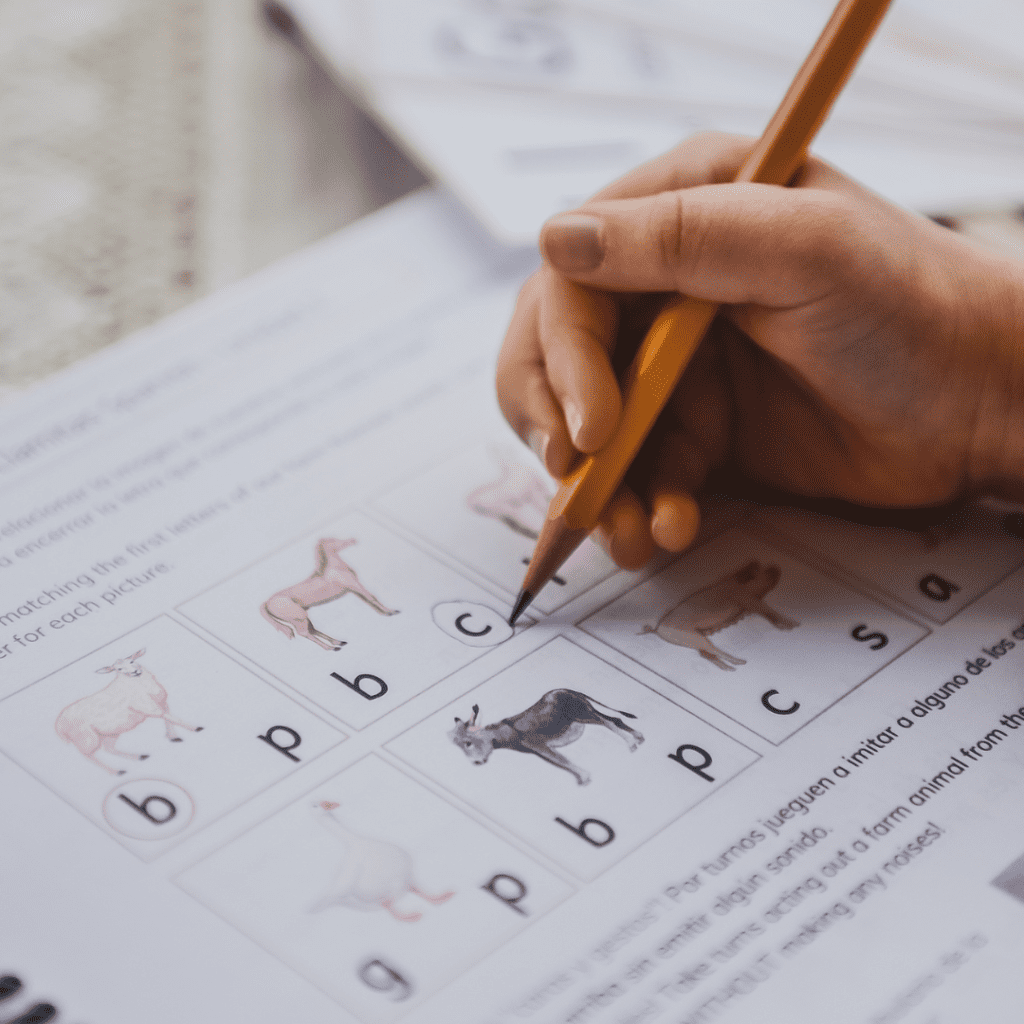
Proficiency in the Spanish alphabet for kindergarten learners includes recognizing and naming all uppercase and lowercase letters in Spanish. A focus on correct pronunciation for Spanish, in contrast to the English alphabet, is important.
Letter sounds and CV syllables are the building blocks needed for learning Spanish vocabulary. Students are introduced to phonics and syllables, learning vowel sounds (a, e, i, o, u) and combining these with consonants to form CV syllables (for example: ma, me, mi, mo, mu).
They’ll also learn to count, pronounce, blend consonant-vowels, and segment syllables in spoken words. For instance, learning that the word casa is two syllables (ca-sa).
These are all crucial steps toward phonological awareness, phonemic awareness, and reading readiness that are learned in kindergarten Spanish lessons.
Related post: El Abecedario: The Spanish Alphabet for Kids
Early Reading and Comprehension
The foundational Spanish skills learned in kindergarten are a precursor to beginning to read and write in Spanish. Taking this a step further, another goal of kindergarten Spanish is to begin building early Spanish reading comprehension skills.
This includes the ability to read short texts appropriate for the kindergarten level. Simple reading activities such as very short recitations, songs, and stories encourage engagement at this age. Learners also work toward answering basic comprehension questions in Spanish.
It may sound like a lot, but kindergarteners gradually build and reinforce these early Spanish reading skills over the school year through fun games and activities.
And guess what? Research also shows that early language development in Spanish actually leads to better learning outcomes in English language arts as well. This means that working on phonics and reading comprehension in Spanish benefits your child’s overall language development!
Basic Math in Spanish
Related Post: Spanish Numbers and Counting
Teaching kindergarten math in Spanish sets a solid foundation to build upon later, while also building math vocabulary. In an elementary Spanish class, students learn to:
- Count in Spanish to 100
- Name 2D shapes
- Add & subtract numbers up to 10
While preschool Spanish lessons typically cover numbers 1–20, the goal in kindergarten is to master numbers 1–100 in Spanish. This includes learning correct pronunciation and being able to count both forward and backward.

Learning the names of two-dimensional shapes in Spanish is another important concept covered in Spanish lessons for 5-year-olds. For example, students learn to identify and name círculo, cuadrado, and triángulo, among others.
In kindergarten, students also begin Spanish addition and subtraction activities using numbers 0 through 10. Basic math vocabulary such as más, menos, and igual are learned. Using manipulatives, toys, and real-world objects at this age helps to teach these basic math concepts and reinforces vocabulary.
Related post: Spanish Numbers and Counting for Kids
How to Support Kindergarten Spanish Learners at Home
If you’re just getting started with your child’s bilingual education in kindergarten, you might be wondering if you’re up to the challenge. Even if you don’t speak Spanish yourself, we’re here to tell you that it is absolutely possible for you to teach your kindergartener Spanish at home!
Here are some helpful tips and resources you can use to support your learner:
Focus on input. Ensure that your child has plenty of exposure to reading and listening to Spanish throughout the day. This means making good use of Spanish resources like songs, picture books, audiobooks, apps, and flashcards.
Be consistent. We recommend sticking to a consistent routine when doing a Spanish homeschool program. This can mean working on Spanish lessons at the same time every day and using songs or rhymes to transition between activities. Repetition is also crucial for learning a new language, so don’t be afraid of repeating songs and activities.
We have a FREE series of gently, illustrated Spanish songs on YouTube called ‘Canciones ilustradas’. Please subscribe for new video alerts!
Related post: Greeting Songs to Start Spanish Class
Keep lessons short. When you’re teaching kindergarten Spanish, it’s important not to overload your child with too much new information. Short lessons of about 30–45 minutes are ideal, though you can expand with interactive activities for more practice. Kindergarteners have short attention spans, so it’s good to keep things moving.
Make it fun! Spanish in kindergarten is not about drilling or studying conjugation charts. Instead, lessons should incorporate music & movement, games, and stories. Choose topics that interest your child so they can apply what they’ve learned in real life. We strongly believe that kids learn better if they’re having fun!
Related post: Traditional Spanish Circle Games
Related post: Spanish Playground Games
Llamitas Spanish Curriculum
Giving your child a bilingual education at home doesn’t have to be difficult. At Llamitas Spanish, we have all of the resources you need to get started building foundational Spanish skills for kindergarten and beyond.

Our Level 1 Curriculum for beginners is perfect for kindergarten or first grade and introduces young learners to foundational Spanish academics. Throughout our 12 thematic and sequential units, your child will learn letters, sounds, numbers, reading, and basic math aligned with grade-level standards.
We’ve included all of the materials and activities you’ll need in this open-and-go elementary Spanish curriculum, including fun games, music, art projects, and more. Plus, with our bilingual scripts, you don’t even need to speak Spanish to teach it to your child.
Ready to get started? Explore our Spanish curriculum for kindergarten and help set your child up for success today!

Lydia is a freelance parenting and education writer. She previously taught English as a second language and enjoys sharing her love of language learning with her children.