

In this post: Learn how you can use music to enrich your Spanish lessons with our very own Spanish songs for kids: Canciones ilustradas!
Ready to skip straight to our FREE playlist for kids? Check it out here: Canciones ilustradas
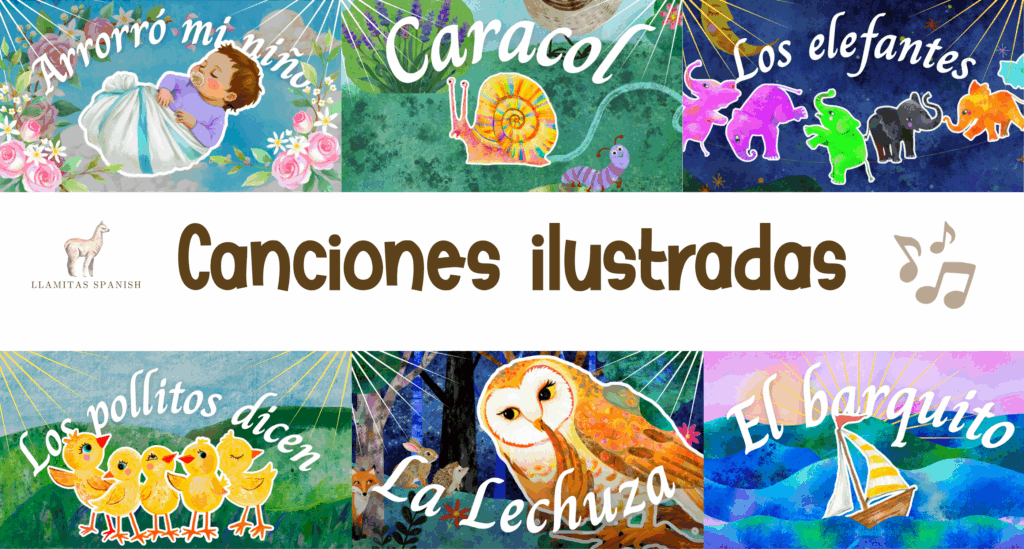
We are big music-lovers in our house, and the kids always love an impromptu dance party or karaoke night at home. Music has been called the “universal language,” and it’s true that so much emotion and meaning can be conveyed through music, whether you understand the lyrics or not.
But music can do even more than this, and it’s actually a great tool to leverage for language learning, too! Music is one of the most natural and joyful ways that kids can practice their Spanish learning at home.
At Llamitas Spanish, we know that many parents have concerns about overstimulation from screens or loud music, and sometimes finding kid-friendly, clean Spanish songs online can take a bit of work.
That’s why we’ve created our very own Canciones ilustradas, a collection of beautifully-illustrated, gentle Spanish songs for kids! These songs are available to anyone for free on YouTube and are a great addition to any homeschool Spanish curriculum.
Table of Contents
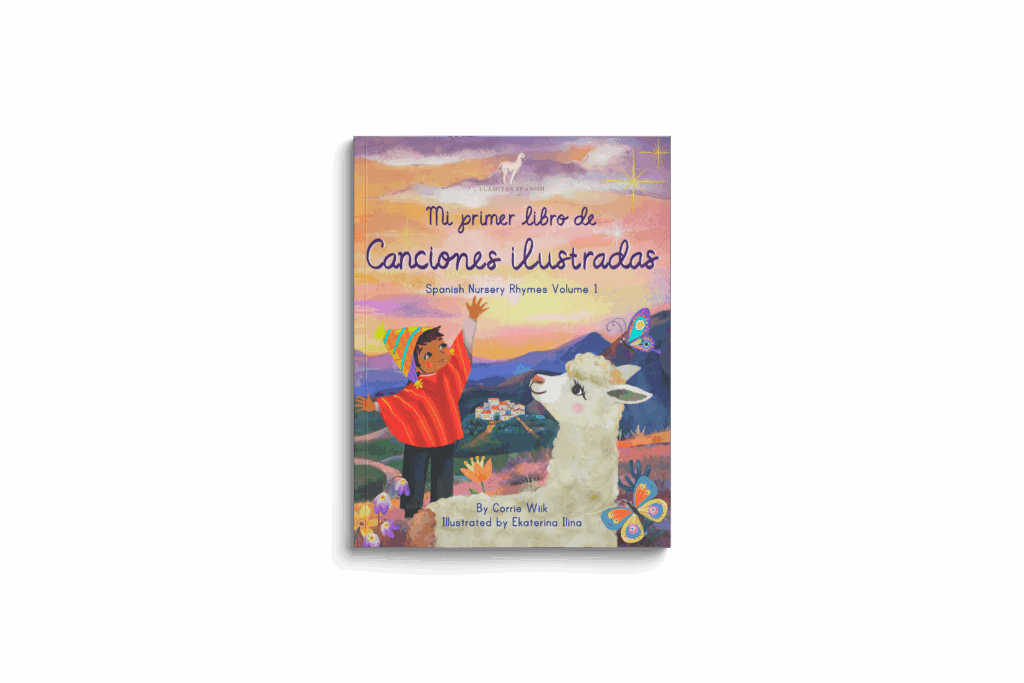
Mi primer libro de canciones ilustradas
Our Spanish Nursery Rhymes Volume 1 book is now available!
Our Volume 1 Canciones Ilustradas book features 10 beautifully illustrated Spanish nursery rhymes inspired by our Level 1 curriculum—designed to make learning feel magical and fun.
Perfect as a companion to Level 1 or as a meaningful gift for bilingual families. Ideal for kids ages 4–10.
Why Music Helps Kids Learn Spanish
The benefits of music have been well-studied in the world of language learning. Now, research shows that this can be even more beneficial for phonology and reading skills when learning a second language.
What is it about music that helps with learning? The use of melody, rhythm, and repetition isn’t just fun for kids who are learning a new language, but actually helps them to learn more effectively!
Here are a few reasons to include music in your Spanish lessons:
- Improved memory. Music has many brain-boosting benefits including enhanced memory.
- Learning in context. Songs are a natural way to practice vocabulary, grammar, and pronunciation without the use of drilling or verb charts.
- Repetition. Spanish songs for kids use simple language and sentence structures that are repeated, making them especially effective for young language learners.
- Input, input, input! While language input like listening to Spanish songs might seem passive, this exposure really is an important part of language learning. This helps them to learn the language in context, going beyond simply memorizing and practicing phrases.
Related post: Musical Spanish Books for Babies and Toddlers
Llamitas Spanish Songs for Kids on YouTube
Ready to get started? Because we believe so strongly in the power of music for Spanish learning, we’ve created our very own Llamitas Spanish songs for kids on YouTube, Canciones ilustradas!
These gentle songs for young learners feature soothing vocals, classic Spanish guitar, and beautiful storybook-style illustrations to accompany the lyrics. Plus, they aren’t just for Llamitas Spanish students—they’re available to anyone for free!
At Llamitas Spanish, we offer a screen-free curriculum and generally steer clear of cartoons, which can be too overstimulating for young children’s brains. That’s why we’ve intentionally designed these videos with slow pacing and calming music, which we believe is better for attention and comprehension.
While anyone can access our collections of canciones infantiles, each song aligns with the thematic units in our curriculum. You’ll find songs about animals and nature like Los pollitos dicen:
Plus traditional Spanish nursery rhymes and lullabies like Arrorró mi niño:
Even classics you already know translated into Spanish, like Rema tu bote (“Row, Row, Row Your Boat”):
These Spanish songs for kids are perfect for reinforcing vocab, grammar, and pronunciation alongside your usual lessons.
Stay tuned, because we’ll also be releasing another series of 10 songs from Level 2 and then Level 3 in the future!
How to Use Spanish Nursery Rhymes in Your Lessons
When you incorporate Spanish nursery rhymes into your lessons, remember that the point isn’t to memorize or perfect the songs. It’s really about comprehensible input, which is a fancy way to say they’re getting exposure to Spanish through music, reading, audio, and other outside sources.
When students hear Spanish that they can understand, it helps them to actively engage with the language outside of their textbook.
With that in mind, here are some tips for how you can use these Spanish kids songs in your homeschool lessons:
- Pair with thematic lessons. All of our nursery rhymes intentionally align with thematic units in our Llamitas Spanish curricula for preschool through elementary school. Even if you aren’t using our curricula, though, the topics covered in the songs make them easy to pair with your own thematic Spanish lessons.
- Make it a routine. Making music a regular part of your homeschool Spanish class is a great idea, and routines provide predictability and structure. Some parents like to incorporate a greeting song or goodbye song to help with transitions, but you can also have music time every day or once a week.
- Use finger play and hand motions. Younger learners especially love learning hand motions to go along with nursery rhymes. This makes it fun for them, but also helps to convey the meaning of the lyrics. Make up some of your own!
- Start with listening. There’s no need to rush into learning to sing these songs, and they don’t need to memorize them. Let your child simply listen to the songs to start, and they can begin to sing along when they’re ready.
- Keep things light. Remember, simply listening to and reading the lyrics along with the songs are both great sources of Spanish input. The more exposure they have to the Spanish language (aka comprehensible input) the better.
As always, at Llamitas Spanish we believe that learning Spanish should be fun! These optional extras are important, but they’re meant to be a bonus alongside their more formal language learning.
Related post: Here’s Why Thematic Spanish Lessons for Kids Actually Work
Learn Spanish at Home With Llamitas Spanish
Teaching Spanish to your kids at home doesn’t have to be hard. At Llamitas Spanish, we’ve made it our mission to set families up for success with our homeschool Spanish lessons for preschool, kindergarten, and the elementary years.

Our open-and-go Spanish curriculum levels have literally everything you need to teach your kids Spanish at home!
We love to share all kinds of freebies and enrichment activities with our community as well, so be sure to subscribe to our YouTube channel and keep an eye out for more upcoming free videos and resources.
