

In this post: How to develop bedtime routines in Spanish with your child including tidying up, bath time and story time.
Bedtime is one of the easiest and most natural moments to build Spanish exposure with your child.
By doing nightly routines in Spanish—cleaning up toys, bath time, reading stories, and singing lullabies—you create consistent, meaningful language input while strengthening connection, which is what language is all about after all.
Table of Contents
Why Bedtime Routines are Perfect for Spanish Exposure
Predictable routines are important for young learners. Not only do they help children to know what to expect throughout the day, but they also build self-confidence, according to HeadStart.
When it comes to learning Spanish, bedtime routines offer even more benefits. Because bedtime follows the same sequence each night, the vocabulary they hear becomes:
- High-frequency (because it’s repeated daily)
- Context-rich (because actions match the words)
- Emotionally positive (bonding time increases retention)
Bedtime becomes both a soothing ritual and a built-in Spanish learning opportunity.
Related post: Daily Routines in Spanish
Spanish Bedtime Routines
If you already have a bedtime routine established, don’t worry. You can still maintain your current routine while adding these Spanish language activities! It’s easy to incorporate Spanish routines during clean-up, bathtime, and story time.
A guardar — Clean Up
Before the bedtime process can begin, there’s usually some tidying up to tackle!
Clean-up song in Spanish
Spend 5 minutes picking up while singing this song:
A guardar, ordenar,
cada cosa en su lugar.
Sin tirar, sin romper,
que mañana hay que volver.
(Play from 0:46–0:57 to hear this stanza.)
A bañarse — Bath Time
Next is bath time! This is one of my favorite parts of the day with the kids. When not too tired, bath time can be an opportunity for more play and Spanish language acquisition.
Play “Veo, veo” (I Spy)
If your child is too young to spell, you can use colors. For example,
- “Veo algo amarillo.” (I see something yellow.)
- “Veo algo azul.” (I see something blue.)
Practice body parts
Use this time of washing to practice parts of the body in Spanish! For example:
- “Vamos a lavar los brazos.” (Let’s wash your arms.)
- “¿Dónde están los pies?” (Where are your feet?)
Add a bath-time song
This is another fun and repetitive song to sing with your child during bath time:
Enjabónate.
Enjabónate.
Pies a cabeza.
Enjabónate.
The repetition and predictable pattern in this song helps your child associate actions with Spanish words.
How can bath time build Spanish vocabulary?
Bath time is hands-on, sensory-rich, and full of movement, making it perfect for learning body parts, colors, and action verbs in Spanish.
Cuentos —Story Time
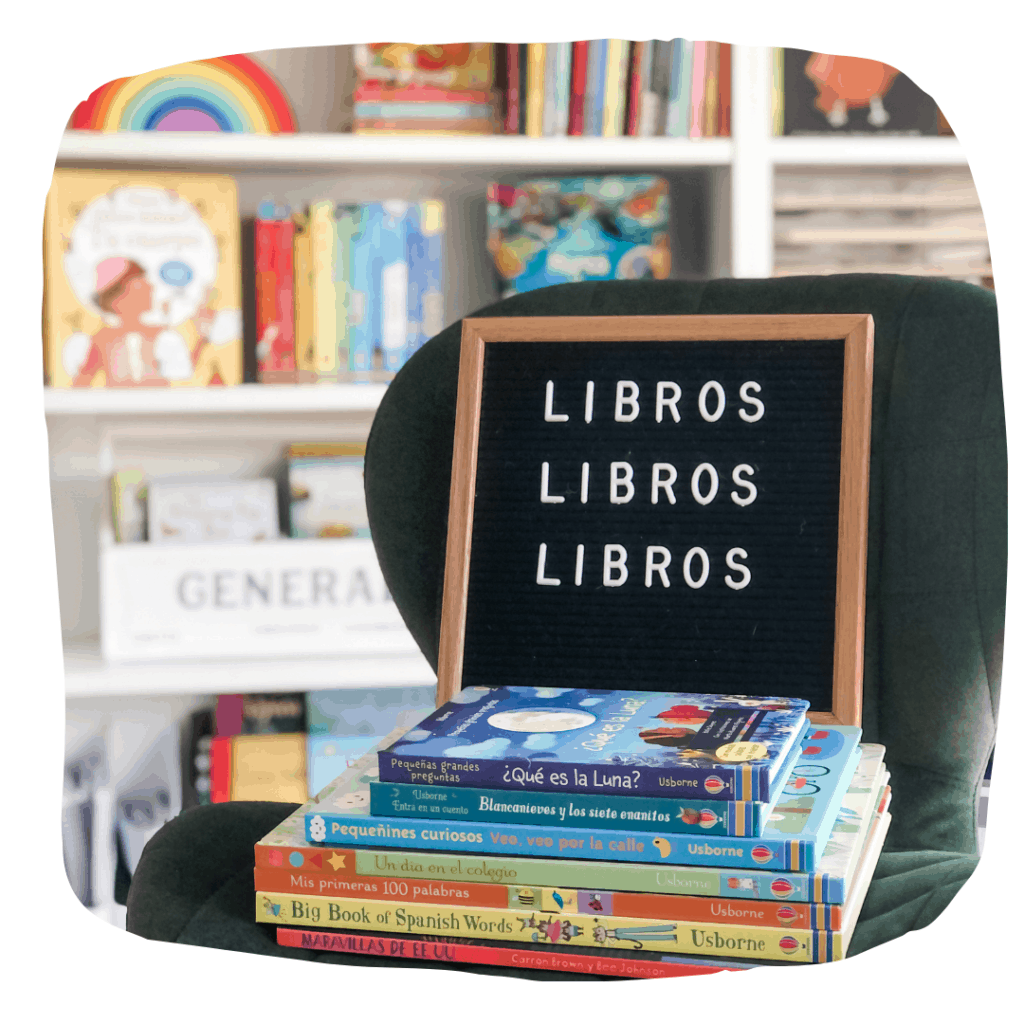
Research shows that reading aloud has a huge impact on your child’s brain development and also family bonding. In fact, a study from Ohio State University found that children who are read just one book a day will hear 290,000 more words by age 5 than those who aren’t regularly read to. That’s amazing!
Rotating your children’s books is fun, but reading the same stories over and over again is great vocabulary consolidation too!
If you haven’t started collecting Spanish children’s books yet, browsing our favorites from the PaperPie bilingual bookshop is a great starting point!
Related post: Best Children’s Spanish Books for Beginners
Canciones de cuna —Lullabies
Spanish lullabies are the perfect way to soothe and prepare your child for sleeping while reinforcing simple vocabulary.
A favorite beginner-friendly lullaby is “La lechuza.” It’s soft, repetitive, and easy to memorize—perfect for your bedtime routine.
Find it in our Level 1 curriculum, and watch our gentle video in our “Canciones ilustradas” series on YouTube!
La lechuza, la lechuza
Hace shhh, hace shhh,
Todos calladitos, como la lechuza
Hacen shhh, hacen shhh.
Another traditional Spanish lullaby is “Arrorró mi niño.” It’s not as simple as the one above, but is very popular amongst Hispanic mamas and is included in our ‘Family unit’ in Level 1.
Arrorró mi niño, arrorró mi sol
Arrorró pedazo de mi corazón
Este niño lindo se quiere dormir
Y el pícaro sueño no quiere venir
Este niño lindo que nació de noche
Quiere que le lleven a pasear en coche
Este niño lindo ya quiere dormir
Háganle la cuna de rosa y jazmín.
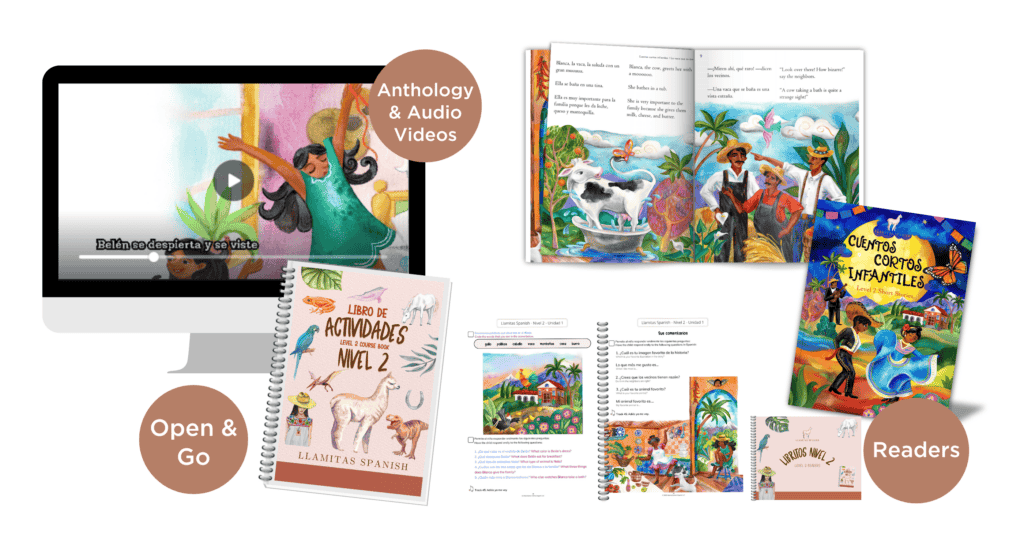
Llamitas Spanish Daily Routine Unit
If you are teaching your children about routines, you will love unit 1 in our Level 2 curriculum!
They’ll learn:
- Daily routine vocabulary
- Reflexive verbs (levantarse, bañarse, acostarse)
- Popular Spanish children’s songs like “Pin Pon es un muñeco”
- A short story about a Mexican girl’s morning routine on her ranch, and a bathing cow!
- Hands-on activities, and more!
As always, our thematic lessons are perfect for making Spanish a natural part of everyday life.

Founder of the Llamitas Spanish® Curriculum and former Spanish teacher. Corrie holds two Master Degrees in Spanish and Education. She lives in San Diego, California with her husband and two bilingual children.