

In this post: Learn why Spanish-first homeschooling keeps language, culture, and belonging at the center of a child’s education for bilingual families.
If you’re a bilingual parent homeschooling in the U.S., there’s a good chance you’ve heard some version of this:
“It’s easier in English.”
“It’s safer in English.”
“It’s the law.”
And so, even families who speak Spanish at home suddenly find themselves homeschooling entirely in English…when Spanish was an option all along.
Table of Contents
Why English-Only Homeschooling Can Cost More Than You Think
The impact of doing so goes far beyond academics. Because when the minority language gets pushed out of learning spaces, it quietly loses its authority. Spanish becomes the language of home, but not the language of thinking, problem-solving, discovering, or creating. And children feel that.
They start to associate English with “school,” “smart,” “real learning”…and Spanish with “side conversations” or “just family.” Not intentionally, but through repetition.
Over time, that separation doesn’t only affect literacy. It shifts identity. It changes the dynamic between you and your child. It can even create distance…because the language you use to comfort them, guide them, and pass down your stories is no longer the language they use to understand their own world.
That’s why this matters. Not just for biliteracy, but for belonging, connection, and the emotional roots that tie a child to the language.
So here’s the truth most of us were never told: you can homeschool in Spanish. And for many of our families, it should’ve been the default.
Let’s break this down with clarity, compassion, and real information, so you can make decisions rooted in confidence, not fear.

What the Law Actually Says about Homeschooling in Spanish
A lot of bilingual parents think homeschooling must be done in English because “that’s what the school system requires.” But that’s not true for most families.
Only four states require instruction to be in English for all subjects except foreign languages (California, Indiana, Illinois, and Rhode Island). Everywhere else? You have more linguistic freedom than you think.
Even in stricter states, you can often teach most subjects other than language arts (like math, science, history, or cultural studies) in Spanish. English does not have to take over your homeschool, even if it appears everywhere else in your child’s life.
For example, in California, private schools filing a Private School Affidavit must provide instruction in English and cover main subjects taught in public schools BUT there is an exception in Education Code section 30 that allows private schools to offer bilingual or dual language instruction. So you CAN still homeschool in Spanish provided English instruction is not impeded.
In addition, bear in mind that compulsory education starts in California when a child turns six years old by September 1st for the relevant school year. Any teaching before that can be entirely in Spanish. Which is ideal as there are huge benefits to teaching your child to read in Spanish first.
Why Spanish-First Homeschooling is so Powerful
Here’s something we often forget: your child learns the concept, not the language.
If your peque can multiply in Spanish, they can multiply. If they can describe the water cycle in Spanish, they understand the science. If they can narrate a story in Spanish, they’re building literacy…not “Spanish literacy,” but literacy.
Academic skills transfer across languages. And English is everywhere (at story time, at your co-op, in every book…). Learning labels in English comes so much easier to your child when it surrounds them.
Spanish-first homeschool doesn’t just preserve your language. It elevates it. It sends the message that Spanish is not just for home…it’s for learning, thinking, questioning, and discovering. And when Spanish becomes a language of knowledge rather than just a language of comfort, something shifts…inside your child and inside your home.

Because here’s a risk no one talks about: kids grow up able to speak Spanish socially…but never fully own it academically.
They might talk to abuelos, but can’t write a letter. They might understand cuentos, but can’t read them confidently. They might love their culture, but never access its literature, its history, its depth.
Homeschooling is your chance to change that.
Three Common Barriers to Homeschooling in Spanish
So Why Don’t More Families Homeschool in Spanish?
Three main reasons come up again and again:
Fear
“What if I mess it up?”
“What if my Spanish isn’t perfect?”
Your bilingualism is not a barrier, it’s an asset. Your kids don’t need academic Spanish from day one. They need exposure, routine, and consistency. And there are so many resources to lean on.
Misinformation
Many parents assume English is required when it isn’t. Others believe teaching in Spanish will “hurt” their child’s English. Rest assured, research shows the exact opposite: a strong foundation in the home language accelerates English literacy.
Related post: Common Myths about Raising Bilingual Kids
Lack of resources
This is the biggest one. Because for years, Spanish-first homeschooling families had to piece everything together from scratch…English-first curriculum here, random printables there, and way too many English-based platforms filling the gaps. But that’s finally changing.
Where Llamitas Spanish Fits In
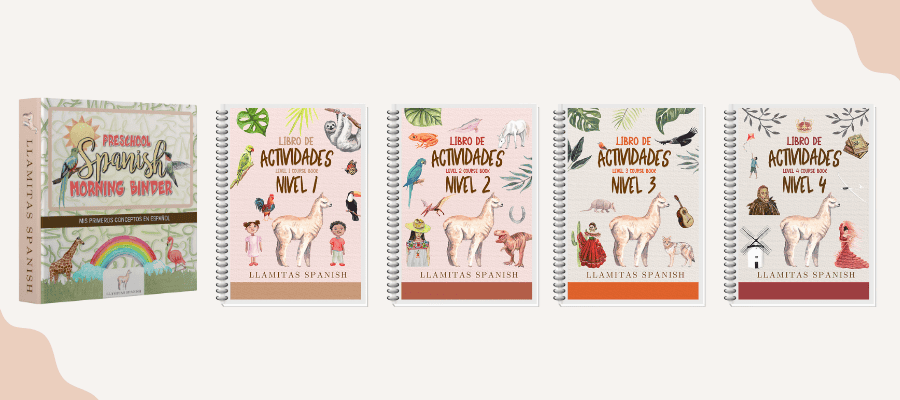
One of the hardest parts of teaching in Spanish is simply…not knowing where to begin. That’s where Llamitas Spanish becomes a lifeline.
Whether you’re:
- easing into Spanish homeschooling,
- supplementing English materials with real Spanish literacy, or
- navigating a state with language restrictions and need a blended approach,
Llamitas gives you a structured, fully bilingual path. It provides:
- developmentally aligned lessons,
- clear language scaffolding,
- cultural richness that reflects our families,
- and the confidence that comes from having an actual roadmap… not just bits and pieces from the internet.
Llamitas doesn’t force you into an English-only mindset or present Spanish as “extra.” It treats Spanish as the language of learning. For bilingual homeschoolers, that changes everything.
What your Child Gains when Spanish Leads
When you choose to educate in Spanish (whether fully or partially) you’re giving your child:
- A stronger academic foundation: Kids learn best in the language they understand best.
- Cultural grounding: Spanish becomes more than a spoken skill; it becomes a tool for thinking, learning, and belonging.
- True biliteracy: Not just bilingual conversation, but bilingual capacity. Reading. Writing. Thinking. Storytelling.
- Freedom from English dominance: Because English is everywhere (media, apps, signs, peers). It does not need your help to survive. Spanish does.
What this is not
This is not about shame. Or about correcting your choices. Or about doing everything “perfectly.”
This is about awareness, possibility, and power. It’s about remembering why you chose homeschooling in the first place: for freedom. For connection. For intention. For ownership over what your child learns and how they learn it.
Choosing to homeschool in Spanish is part of exercising that freedom.
Concluding Thoughts
So ask yourself…
If you’re homeschooling in English:
Is it fear? Is it misinformation? Is it lack of resources?
Or is it simply that no one ever told you…you could homeschool in Spanish? Because you can. And your child deserves the chance to learn, not just the language, but in the language that built your family’s story.
And if you need structure, guidance, or a starting place? Llamitas is ready to walk this journey with you.
Homeschooling gives you the chance to build an education that reflects your values, not the default. Whether you choose full Spanish instruction or a bilingual blend, your homeschool can be a place where Spanish is lived, learned, and loved.
You are not alone. You are capable. And your language belongs in your homeschool.
Lucía Garrett is the founder of Pato Pato, a Latina-owned educational brand helping families raise Spanish-first, biliterate kids through play, culture, and connection. Born in Buenos Aires and raised in Mexico City, she now homeschools her two boys fully in Spanish while bringing together resources for families across the U.S. Lucía writes about bilingual parenting, legacy, and identity with a voice grounded in her lived experience. Her mission is simple: make Spanish feel powerful, intentional, and accessible for every family.